 logo
logo


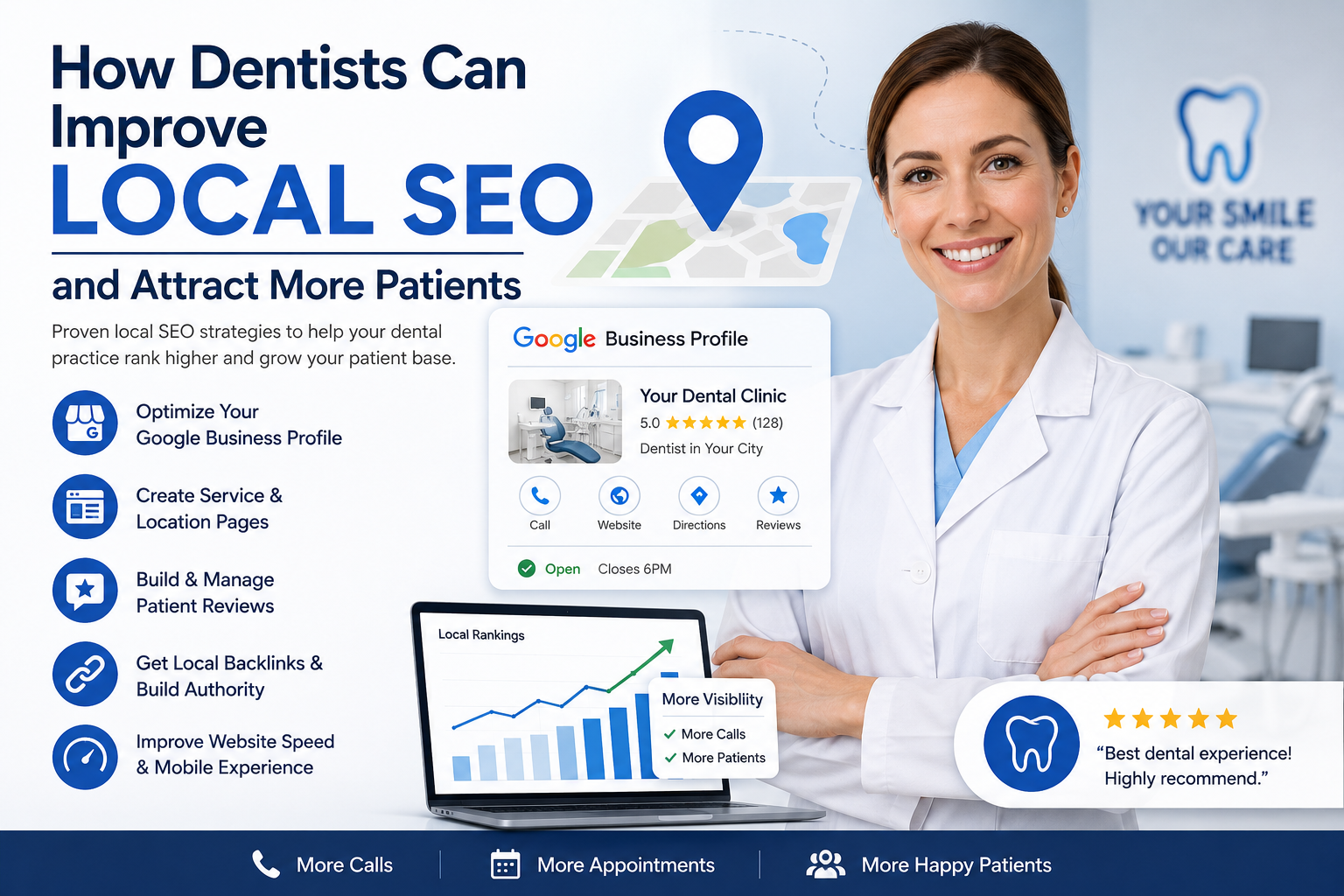
For dental practices, visibility in local search results is no longer optional—it directly affects patient acquisition and long-term growth. When people search for phrases like “dentist near me,” “emergency dentist in Manchester,” or “teeth whitening Birmingham,” they usually intend to book an appointment rather than simply gather information.
Unlike many industries where customers compare multiple providers over weeks or months, dental patients often make decisions quickly. If your practice appears prominently in local search results and map listings, you are more likely to receive calls, appointment requests, and walk-in inquiries.
Successful local SEO for dentists involves more than simply having a website. It requires optimizing your local presence, building trust signals, improving user experience, and creating content that matches how potential patients search.
Below are ten proven strategies dental practices can use to improve local SEO and increase patient bookings.
1. Fully Optimize Your Google Business Profile
For local intent searches, your Google Business Profile (GBP) can sometimes be more influential than your website itself.
Google often displays map listings before traditional organic search results, which means many patients will interact with your profile before they ever visit your website.
Your profile should include:
- Exact business name
- Correct phone number
- Accurate address
- Website link
- Appointment booking link
- Working hours
- Service descriptions
- Images and videos
- Treatment information
Selecting the right categories also matters.
Examples include:
- Dentist
- Cosmetic Dentist
- Emergency Dental Service
- Orthodontist
- Pediatric Dentist
Avoid keyword stuffing your business name.
Poor example:
“Manchester Best Cheap Emergency Dentist Clinic #1”
Better example:
“Smile Dental Care Manchester”
Descriptions should also clearly communicate your services.
Instead of writing: “We provide quality dental services.”
Use: “Private family dentist in Leeds offering dental implants, Invisalign, emergency appointments, and cosmetic dentistry.”
Maintain activity by publishing weekly posts such as:
- Smile makeover examples
- Dental health tips
- New technologies
- Seasonal offers
- Practice updates
Google values active and updated profiles.
2. Create Dedicated Service and Location Pages
One of the most common mistakes dental websites make is relying on only a homepage and a general services page.
Patients search for highly specific treatments and locations.
A stronger website structure would look like:
/dental-implants-london/emergency-dentist-london/teeth-whitening-london/invisalign-london/family-dentist-london
Each page should contain unique information, including:
Treatment explanation
Explain the procedure in simple language.
Frequently asked questions
Answer common concerns:
- Does it hurt?
- How long does it take?
- Is financing available?
Pricing information
Approximate pricing improves transparency and trust.
Patient testimonials
Real experiences help increase conversion rates.
Before and after examples
Visual proof often influences decisions.
Local relevance
Mention local areas served and community references naturally.
Avoid creating dozens of duplicate pages where only the city name changes. Search engines generally view this as low-value content.
3. Maintain Consistent NAP Citations
NAP stands for:
Name
Address
Phone Number
Search engines compare your business information across multiple directories.
Even small differences can create trust issues.
For example:
Website
Smile Dental Care
12 Main Street
020-1234-5678
Directory listing
Smile Dental Clinic
12 Main St.
02012345678
While these appear similar, inconsistency creates confusion for search engines.
Important citation sources include:
- Yelp
- Bing Places
- Apple Maps
- Local directories
- Healthcare listings
- Dental-specific directories
Ensure consistency in:
- Business name
- Phone number formatting
- Address formatting
4. Focus on Review Velocity, Not Just Review Quantity
Reviews influence both rankings and patient decisions.
Many clinics only focus on getting as many reviews as possible. However, review consistency is often more valuable.
Receiving five reviews every month may be stronger than receiving fifty reviews in one week and then none afterward.
Request reviews after:
- Routine cleanings
- Invisalign completion
- Implant procedures
- Cosmetic treatments
Helpful prompts include:
“What treatment did you receive?”
“How was your experience with our staff?”
Natural keywords frequently appear inside reviews:
“Best emergency dentist in Bristol.”
“Excellent Invisalign treatment.”
These terms strengthen local relevance.
Always respond to patient reviews because engagement signals credibility.
5. Implement Dental-Specific Schema Markup
Schema markup helps search engines understand website content more effectively.
Recommended schema types for dental practices include:
- LocalBusiness
- Dentist
- FAQ
- Review
- Service
- Breadcrumb
Potential benefits include:
- Rich snippets in search results
- Increased local relevance
- Better click-through rates
Structured data does not directly increase rankings, but it improves search visibility.
6. Improve Mobile Speed and User Experience
Most local dental searches happen on smartphones.
If your website loads slowly, users often leave before booking.
Recommended targets:
- Mobile load time under three seconds
- Click-to-call buttons
- Fast appointment forms
- Minimal popups
- Easy navigation
Common issues affecting dental websites:
- Oversized images
- Heavy animations
- Slow hosting
- Unoptimized scripts
A fast website improves both SEO and conversion rates.
7. Build Local Authority Links
Local backlinks often outperform random links from unrelated websites.
Strong local link opportunities include:
- Community newspapers
- Sports organizations
- Schools
- Chambers of commerce
- Health organizations
- Community events
Examples:
- Sponsoring a local football team
- Hosting oral health seminars
- Supporting charity events
- Publishing educational resources
These links build trust and local authority.
8. Create Local Educational Content
Many dental websites completely ignore informational searches.
Patients frequently ask questions before booking.
Examples:
- “How much do dental implants cost in Leeds?”
- “NHS vs private dentist in Manchester”
- “How long does Invisalign take?”
- “What should I do during a dental emergency?”
Educational content helps generate:
- Top-of-funnel traffic
- Backlinks
- Brand trust
- Topical authority
Patients often discover practices through informational content and later convert into appointments.
9. Strengthen Internal Linking
Internal links help distribute authority across your website.
A common issue is isolated service pages with no supporting connections.
A stronger structure looks like this:
Homepage
↓
Dental Implants
↓
Implant Cost Guide
↓
Before & After Results
↓
Book Consultation
This structure helps search engines understand page relationships while guiding users toward conversion actions.
10. Track Patient-Generating Keywords
Many dental clinics track broad keywords that do not generate appointments.
Avoid focusing only on:
❌ Dentist
Instead, monitor high-intent searches:
✔ Emergency dentist near me
✔ Invisalign clinic [city]
✔ Dental implants [city]
✔ Teeth whitening [city]
✔ Same day dentist [city]
Monitor performance indicators including:
- Google map rankings
- Phone calls
- Appointment submissions
- Direction requests
- Google Business Profile actions
These metrics connect SEO efforts directly to patient growth.
Local SEO has become one of the most effective growth channels for dental practices because patients actively search with strong intent to book.
For most clinics, the formula is relatively straightforward:
Optimized Google Business Profile + Reviews + Service & Location Pages + Local Authority Links + Technical SEO
When these elements work together consistently, practices usually experience stronger search visibility, increased trust, and ultimately more patient appointments.
Dental practices that invest in local SEO today are positioning themselves for sustainable patient acquisition rather than depending entirely on paid advertising or referrals.
FREQUENTLY ASKED QUESTIONS
1. How long does it take for a dental practice to see results from local SEO?
Most dental practices begin seeing measurable improvements within 3–6 months, although this depends on competition, website authority, and current optimisation levels. Actions such as improving your Google Business Profile and generating patient reviews can produce earlier gains, while content development and authority building usually take longer. Local SEO should be viewed as a long-term patient acquisition strategy rather than a quick fix.
2. Is Google Business Profile more important than a dental website?
Both are important, but for local searches, your Google Business Profile often acts as the first point of contact. Patients searching for terms like “emergency dentist near me” frequently call directly from Google Maps without visiting a website. However, your website supports rankings by providing service details, treatment information, trust signals, and booking options.
3. How can dentists get more patient reviews without appearing pushy?
The most effective approach is to request reviews naturally after positive patient experiences, such as after a routine cleaning, Invisalign completion, implant treatment, or cosmetic procedure. Staff can simply ask:
“We’re glad you had a good experience today. Would you mind sharing your feedback through a quick Google review?”
Sending automated review requests through SMS or email after appointments can also help maintain a consistent flow of reviews.
4. Why isn’t my dental clinic appearing in Google Maps even though I have a website?
A website alone does not guarantee visibility in Google Maps results. Missing or incomplete Google Business Profile information, inconsistent business details across directories, limited reviews, weak local authority signals, or poor website optimisation can all affect map rankings. Local SEO requires multiple signals working together rather than a single optimisation.
5. Which dental services usually generate the highest SEO return on investment?
High-intent treatments generally produce stronger returns because patients actively search before booking. Common examples include:
- Dental implants
- Invisalign
- Emergency dentistry
- Teeth whitening
- Cosmetic dentistry
- Same-day appointments
These services often have strong search demand and higher patient value, making them ideal targets for dedicated SEO campaigns.
Ready to Grow Your Dental Practice Online?
If you want your clinic to rank higher in local searches, attract more qualified patients, and increase appointment bookings across the UK, a structured dental SEO strategy can make a measurable difference.
Contact SEO MOJO for professional Dentist SEO services in the UK and get help with local SEO, Google Business Profile optimisation, content strategy, technical SEO, authority building, and patient-focused growth campaigns designed specifically for dental practices.